

In the world of professional security and private investigation, gathering information often requires staying at a safe distance. While traditional bugs and hidden microphones are effective, they usually require physical access to a room. This is where the laser microphone changes the game.
Unlike standard audio equipment, laser technology allows for high-quality listening without ever stepping foot inside a building. Here is why this technology is becoming the gold standard for modern surveillance.
1. Zero Physical Contact
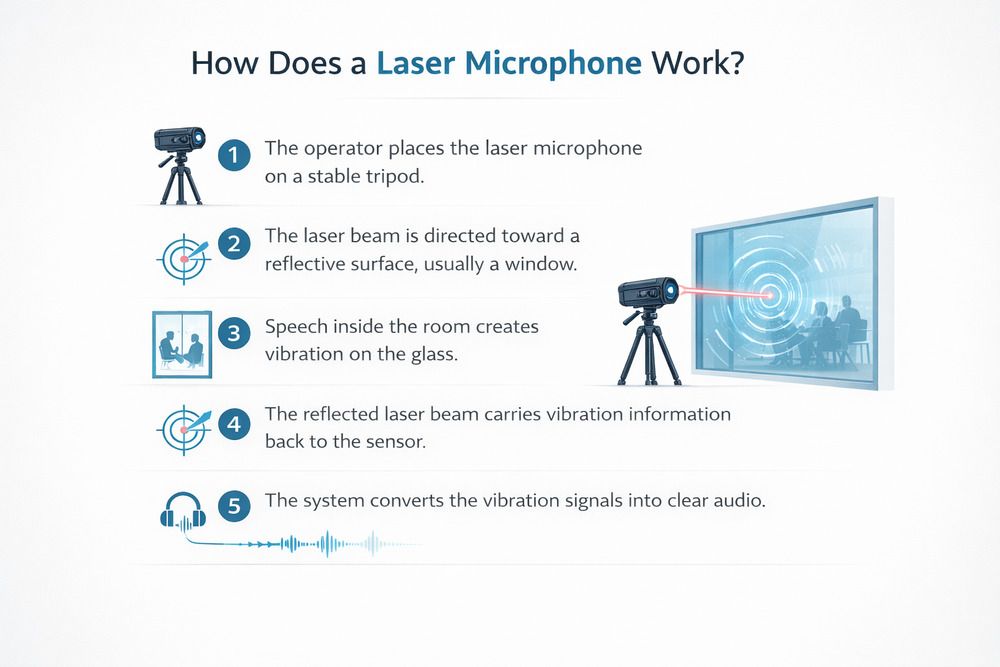
The biggest advantage of a laser microphone is its "non-intrusive" nature. You don't need to pick a lock, plant a device, or worry about battery life on a hidden bug. By simply pointing a laser beam at a window from a distance, you can capture clear audio from the vibrations on the glass. This eliminates the risk of being caught while installing equipment.
2. Overcoming Physical Barriers
Thick walls and soundproofed doors often block traditional listening devices. However, windows are the "weak point" of any secure room. Because sound waves cause microscopic vibrations on glass surfaces, a laser microphone can "read" these movements and convert them back into crystal-clear speech.
3. Long-Range Reliability
Modern laser listening systems can operate over hundreds of meters. This allows investigators to stay in a vehicle or a neighboring building, keeping them completely invisible to the target. It is the perfect solution for high-stakes environments where proximity is a danger.
4. Rapid Deployment
In many situations, you don’t have hours to plan a surveillance operation. A laser microphone system can be set up and calibrated in minutes. Once the beam is aligned with the target window, the audio feed is instantaneous.
Conclusion
As surveillance technology evolves, the ability to monitor a location from a distance is no longer a luxury—it’s a necessity. Whether for corporate security or private investigations, the laser microphone offers a blend of safety and efficiency that other tools simply cannot match.
Want to learn more about the science behind this? Check out our detailed Laser Microphone Guide: How It Works & Long Distance Listening Technology for a deep dive into the physics of optical audio.